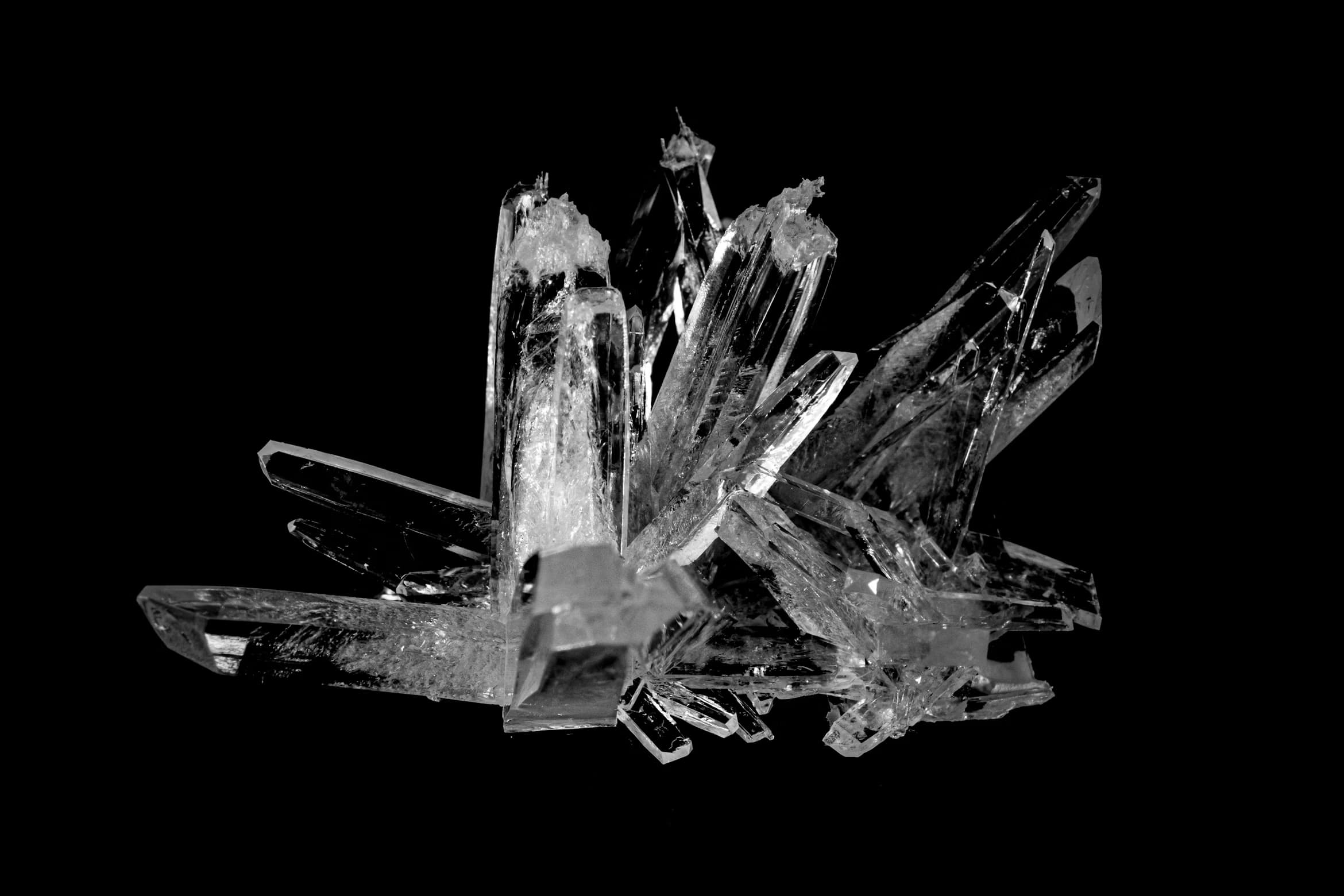
Walker's Crystals
Quartz
Overview
Quartz is one of the most abundant minerals on Earth, found in nearly every geological environment. Its name derives from the German word "Quarz," which has roots in the Slavic word meaning "hard." This remarkable mineral has been valued throughout human history for both practical applications and ornamental purposes.
Quick Facts
- Color: Clear, white, or colorless (pure form)
- Mohs Hardness: 7
- Chemical Composition: Silicon dioxide (SiO₂)
- Crystal System: Trigonal
- Luster: Vitreous (glass-like)
- Specific Gravity: 2.65
Where It's Found
Quartz is found worldwide and occurs in virtually all mineral environments. Major deposits include:
- Brazil — One of the largest producers of high-quality quartz crystals
- Arkansas, USA — Known for exceptionally clear "Hot Springs" quartz
- Madagascar — Source of many unique quartz varieties
- Alps, Europe — Historic source of fine crystal specimens
Formation
Quartz crystals form in a variety of geological environments, most commonly:
- Igneous rocks — Crystallizing from silica-rich magma as it cools
- Metamorphic rocks — Recrystallizing under heat and pressure
- Hydrothermal veins — Precipitating from hot, silica-rich fluids
- Sedimentary environments — As a cementing agent or through biological processes
Uses
Industrial Applications
- Electronics — Piezoelectric properties make it essential for oscillators in watches, radios, and computers
- Glassmaking — Primary raw material for glass production
- Abrasives — Used in sandpaper and sandblasting
Scientific Instruments
- Optics — High purity quartz is used in lenses and prisms
- Laboratory equipment — Quartz glass withstands high temperatures
Varieties
Quartz occurs in many varieties based on color and formation:
- Amethyst — Purple variety colored by iron impurities
- Citrine — Yellow to orange variety
- Rose Quartz — Pink variety
- Smoky Quartz — Brown to black variety
- Milky Quartz — White, opaque variety